Modern RL: Preferences, World Models, and Machine Minds
The Same Inversion, at Frontier Scale
The last two chapters built one machine and pointed it at smaller and smaller hidden things: a goal, a belief, a reward, another mind. All of it was hand-sized — three grid cells, two doors. This chapter is the same machine at the scale of the systems making headlines: aligning large language models, planning by imagining, and the genuinely unsettled question of whether those models have minds to read at all.
Alyssa: “So the toy inversions weren’t toys. They were the mechanism — and now we just run it bigger.”
Jamal: “Bigger, and with a twist. Up to now we watched whole demonstrations. The frontier mostly learns from something cheaper: a human glancing at two answers and saying that one’s better.”
That twist — learning a reward from preferences instead of demonstrations — is exactly how today’s models are aligned, and it is inverse RL wearing a new coat. We’ll build it, then survey two more frontier ideas the same machine illuminates (amortized mind-reading and world models), and end on the honest state of the LLM Theory-of-Mind debate.
RLHF and DPO Are Inverse RL
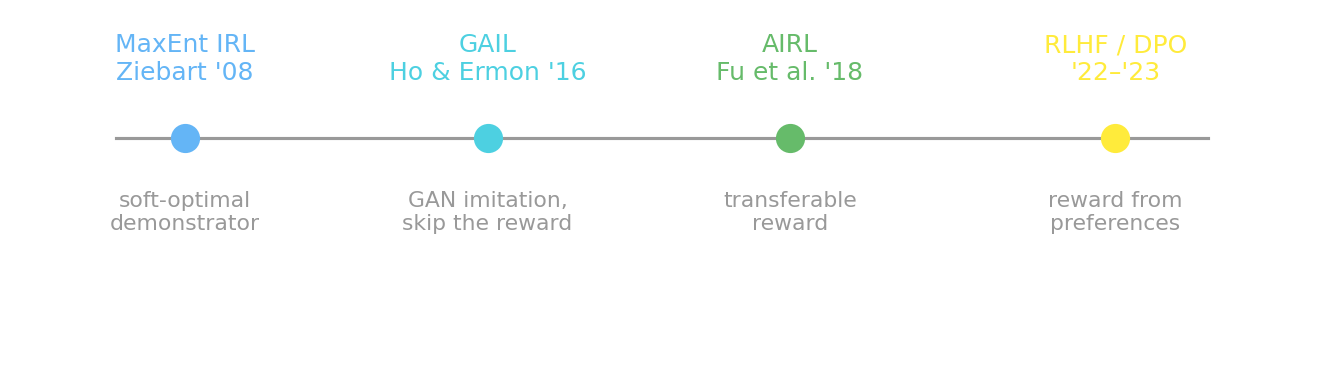
You cannot write down a reward function for “be helpful and harmless.” So modern alignment does not try. RLHF — reinforcement learning from human feedback — instead (1) shows people pairs of model outputs and records which they prefer, (2) fits a reward model to those preferences, then (3) optimizes the policy against that learned reward. Step (2) is the whole of inverse RL: recover a hidden reward from observed human choices. DPO (direct preference optimization) folds (2) and (3) together — it shows the optimal RLHF policy implies an implicit reward, so you can optimize the policy directly on preferences — but the inference problem underneath is identical.
The choice model is Bradley–Terry, the same logistic form we have met as the softmax: a human prefers item $i$ over $j$ with probability
$$P(i \succ j) \;=\; \sigma\!\big(r_i - r_j\big), \qquad \sigma(x)=\frac{1}{1+e^{-x}}.$$In words: the probability you prefer $i$ over $j$ is a logistic function of the reward gap $r_i - r_j$. The new symbol $\sigma$ (sigma) is the logistic (or sigmoid) function — the S-shaped curve that squashes any real number into the interval $(0,1)$, so it can serve as a probability. A large positive gap pushes $\sigma$ toward $1$ (you almost always pick $i$); a large negative gap toward $0$; and a gap of zero gives exactly $\sigma(0) = 0.5$, a coin flip between two items you value equally. This is just a pairwise softmax — $P(i \succ j) = \frac{e^{r_i}}{e^{r_i}+e^{r_j}} = \sigma(r_i - r_j)$ — the two-item version of Chapter 23’s policy. Better items win more often, not always — noisy-rational raters, exactly like the noisy-rational agents of Chapter 23. And fitting the latent rewards $r$ from observed preferences is inverse RL by the same Bayes’ rule as goal inference:
$$P(\text{reward} \mid \text{preferences}) \;\propto\; P(\text{preferences} \mid \text{reward})\;P(\text{reward}),$$where the likelihood is the Bradley–Terry choice model. We recover a reward instead of a goal, but the machine is identical. We can do the literal reward-modeling step in GenJAX: latent rewards with a prior, each observed comparison a flip whose probability is $\sigma(r_i - r_j)$, then condition on the humans’ choices and read off the posterior-mean reward. (We recover that posterior by importance sampling — draw many reward vectors from the prior, weight each by how well it explains the observed preferences, and take the weighted average; a standard tool when the posterior has no closed form.)
To make it concrete — and to see that this is the same thing minds do — we’ll recover Chibany’s food preferences from its choices. Watch Chibany pick between tonkatsu, hamburger, and ramen over many meals; from those pairwise choices alone, fit a Bradley–Terry reward and read off how much it likes each.
| |
Output:
Watched Chibany make 90 choices between pairs of foods.
recovered tastes from the choices alone (mean-centered):
  food        true   recovered
  tonkatsu   +1.50    +1.36
  hamburger  +0.00    -0.00
  ramen      -1.50    -1.36
recovered ranking: tonkatsu > hamburger > ramen
From nothing but $90$ of Chibany’s “this over that” choices, we recovered its hidden tastes for all three foods — correct ranking, roughly correct spacing. Note the recovered numbers ($+1.36, 0, -1.36$) are a little compressed toward zero versus the truth ($+1.5, 0, -1.5$): finite noisy data and the normal prior pull the estimate gently inward. And the reward is identifiable only up to an additive constant: every preference depends on the difference $r_i - r_j$, so adding the same constant to all rewards leaves every difference — and thus every preference — unchanged. That is why we mean-centered both columns before comparing them. That residual ambiguity is the same ill-posedness from Chapter 23, alive and well at the heart of how every aligned model is trained. Scale this up — millions of preferences, a transformer for the reward model — and you have RLHF.
🧠 You already do this — reading a friend’s tastes
The Bradley–Terry model is not just an engineering convenience. In its general form it is the Luce choice rule (Luce 1959), the classic cognitive model of how people choose — and inverting it to recover someone’s preferences from their choices is something human minds do constantly. Developmental psychology calls it the naïve utility calculus: from infancy, people infer the costs and rewards behind an agent’s choices by running its decision-making backwards, $P(\text{rewards}\mid\text{choices}) \propto P(\text{choices}\mid\text{rewards})\,P(\text{rewards})$ (Jara-Ettinger, Gweon, Schulz & Tenenbaum 2016) — and even young children do this rationally (Lucas et al. 2014, “the child as econometrician”). So RLHF’s reward model is the machine version of an everyday act of Theory of Mind: you learned Chibany likes tonkatsu the same way you learn a friend’s tastes by watching what they order — and the same way Chapter 23 inferred a goal from actions. Reading minds and aligning models are, once again, the same inversion.
Reward hacking is the positive cycle at scale
Chapter 22 showed an agent farm a badly-shaped reward — pacing a praise-giving path forever instead of finishing. A learned reward model has the same failure mode, now at frontier scale: the policy discovers inputs that score high on the reward model without being genuinely good (sycophancy, length-gaming, confident nonsense). The reward model is an approximation of human values, and optimizing hard against an approximation finds its cracks. This is reward hacking — the same shape as the Chapter-22 positive cycle (optimize a proxy, discover its loopholes), though the cure differs: we can’t reshape true human values, so the effort goes into making the learned reward robust to adversarial inputs.
🧠 A reward model is a crowd — and crowds can be wise or mad
RLHF distills the preferences of many people into a single reward, and whether aggregating human signals yields wisdom or noise is itself a science. Computational studies of collective intelligence show the answer turns on the social-learning strategy: conformist (frequency-dependent) copying drives large, uncertain crowds to herd, while smaller groups and easier judgments produce genuine wisdom-of-the-crowd (Toyokawa, Whalen & Laland 2019). And people generalize from others’ choices using the very machinery of this unit — folding peers’ behavior into their own value-generalization, just down-weighted as noisier (Wu, Schulz, Speekenbrink, Nelson & Meder 2018; Witt, Toyokawa, Laland, Gaissmaier & Wu 2024) — social inverse RL. So an RLHF pipeline is a multi-agent version of everything in this unit: many minds, read and aggregated.
Two Ways to Read a Mind
In Chapters 23–24 we read minds the Bayesian way: enumerate the hypotheses, score each with a forward planner, normalize. It is interpretable and sample-efficient — but it requires running the planner at inference time, once per hypothesis, which does not scale to rich worlds.
The frontier’s alternative is amortized inference: pay the cost once, up front, by training a neural network to map behavior straight to the answer. ToMnet (Rabinowitz et al. 2018) does exactly this — a “Theory-of-Mind network” watches many agents act and learns to predict their behavior and their (possibly false) beliefs, in a single forward pass, with no explicit planner inside. It is the learned, scalable cousin of the explicit Bayesian inversion you built: same inverse problem — recover an agent’s mental state from behavior — traded from exact-but-slow to learned-but-opaque.
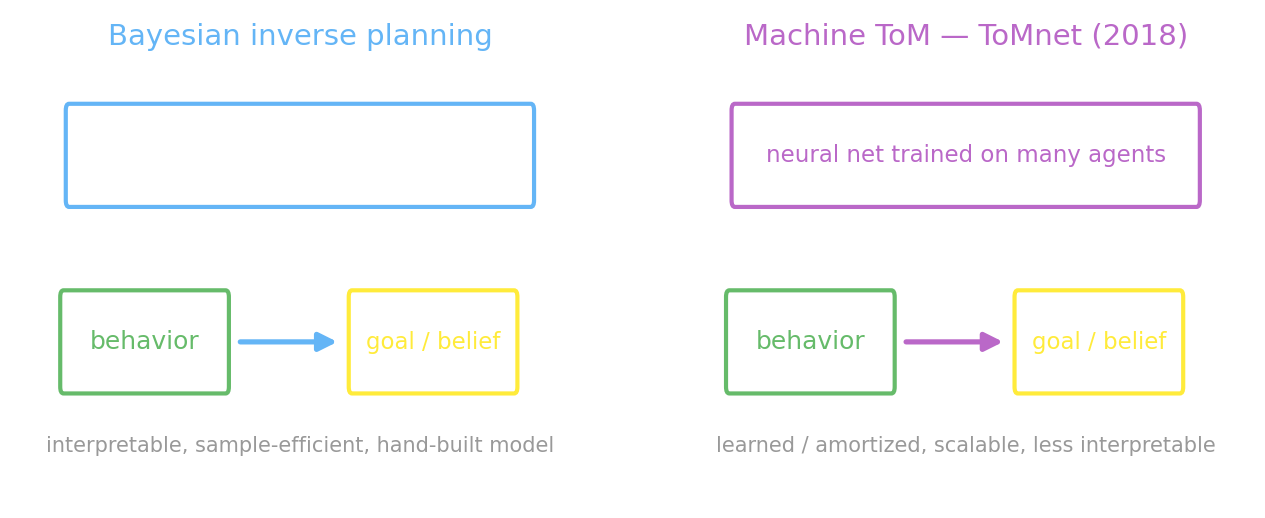
This is the same exact-versus-amortized tradeoff you will see everywhere in modern probabilistic ML: enumeration and importance sampling (what we ran above) are exact but slow; a trained network is fast but inherits whatever its training distribution taught it.
World Models: Planning by Imagining
Chapter 22 ended on simulation-based RL — learn a model of the world, then plan by simulating rollouts inside it (Dyna, then Monte-Carlo Tree Search). That is the engine of the most capable agents today, and the frontier pushes it in one direction: make the learned model abstract.
- MuZero (Schrittwieser et al. 2020) learns a model not of the literal environment but of a latent state that is only good enough to predict reward, value, and policy — then runs MCTS in that latent space. It mastered Go, chess, and Atari without being told the rules, learning a world model purely from interaction.
- Dreamer (Hafner et al. 2020, 2023) learns a latent world model and then trains its policy entirely inside the model — “learning behaviors by latent imagination,” planning in a dream rather than in the costly real world.
Both are the Chapter-22 idea — know a model, simulate to plan — with the model learned and compressed. And the connection back to this unit is direct: a world model that must track a hidden environment state from partial observations is maintaining a belief, exactly the POMDP machinery of Chapter 24, now learned by a network rather than written by hand — which means the belief-updating and decision tools from that chapter (filtering the hidden state, α-vectors, posterior sampling) apply, in principle, to planning inside the learned model — Dreamer’s latent state, for instance, is refreshed from each new observation, a learned belief filter.
🧠 The mind as a physics engine
“Plan by imagining” is also a leading account of how people think. Cognitive scientists argue the mind runs an intuitive physics engine — a noisy mental simulation of how the world will unfold — and uses it to predict and act: you catch a ball, stack dishes, or judge whether a tower will topple by imagining the outcome (Battaglia, Hamrick & Tenenbaum 2013; Hamrick 2019). Tomer Ullman and colleagues put it sharply — the mind runs something like a game engine in the head (Ullman, Spelke, Battaglia & Tenenbaum 2017). The same engine grounds causal and moral judgment: to decide whether one event caused another — or who is to blame — people imagine the counterfactual, re-running the simulation with the candidate cause removed or perturbed to see whether the outcome would change (Gerstenberg’s counterfactual simulation model; Gerstenberg & Stephan 2021; Gerstenberg 2024). MuZero and Dreamer are the engineering rediscovery of the same principle: a learned world model you roll forward in imagination to decide. This is why the thread belongs to computational cognitive science as much as to RL — both fields converged on simulation-as-planning.
Do LLMs Have a Theory of Mind?
The unit opened by inferring a goal from a few footsteps. It ends on the question that inference makes unavoidable: when a large language model passes the tasks we use to measure Theory of Mind, does it actually have one? Here the honest answer is contested, and this book takes the skeptical side — not because the capabilities aren’t striking, but because the evidence does not yet license the strong claim.
The case for is real: GPT-4-class models pass a large fraction of classic false-belief vignettes, often at adult or near-adult level, and clear irony, hinting, and faux-pas batteries (Kosinski 2024; Strachan et al. 2024). Taken at face value, that looks like mentalizing.
But face value is exactly what is in doubt:
- Minimal, belief-preserving perturbations break them (Ullman 2023). Take a standard false-belief story — Anne hides a toy in a box, leaves, the toy is moved — which a capable model resolves correctly by reporting Anne’s false belief. Now make the box transparent, so Anne could plainly see the toy move: a mind that tracks beliefs handles this trivially (Anne now knows), yet models often still report the old false belief. Failing on a change that is irrelevant to the belief itself points to surface pattern-matching, not mental-state inference — a robust Theory of Mind would not break on a cosmetic tweak.
- The wins may be artifacts. Apparent faux-pas competence can reflect response bias rather than inference; and because these vignettes and their templates are all over the training data, high scores may reflect memorization / contamination rather than reasoning (Pang 2025). Morgan’s Canon applies — do not attribute a higher faculty when a lower one suffices — which is a call for conservatism: the current evidence does not require genuine mental-state inference, not that it rules such inference out.
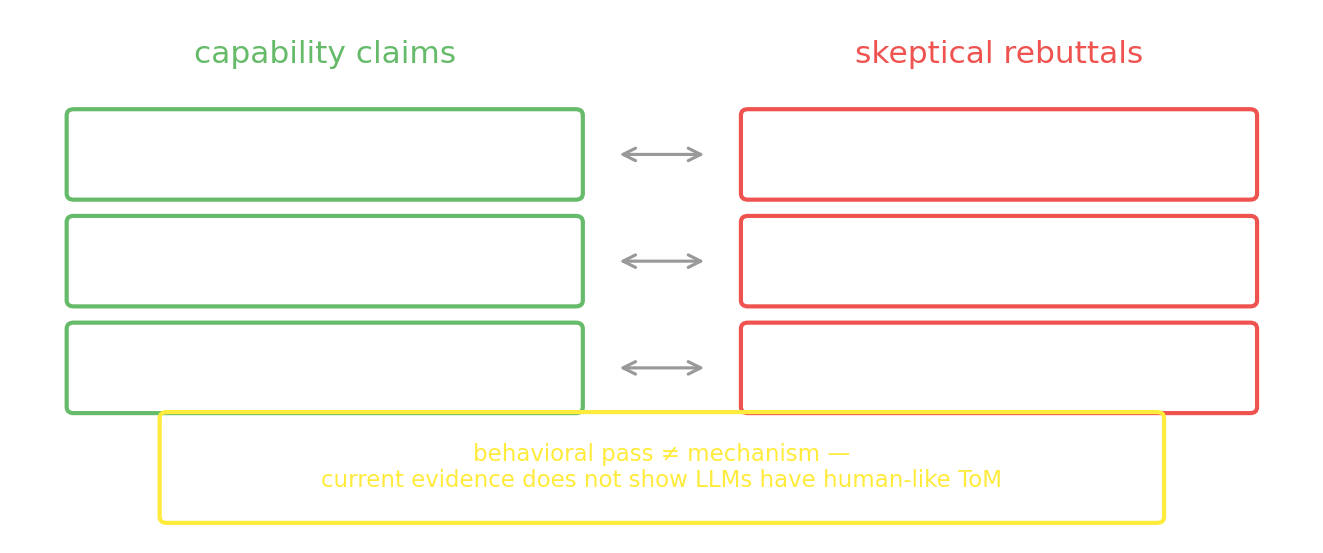
The throughline is one sentence: a behavioral pass is not the mechanism. Passing the test that was designed to detect a capability in humans is not the same as having the capability, when the system could be matching patterns instead. The defensible 2026 position is the cautious one: current evidence does not show that LLMs have a human-like Theory of Mind — impressive, ToM-shaped pattern-matching, not demonstrated mental-state representation. That is not a permanent verdict; it is a statement about what today’s evidence supports.
🧠 The same scrutiny — beyond text, beyond ToM
The Theory-of-Mind debate is one front in a larger question computational cognitive science is now pressing on frontier models: do they generalize and represent like people, or merely match our outputs? The method is this book’s method — compare model behavior to human behavior on tasks designed to expose the mechanism. Across modalities, large language models predict human similarity judgments in six perceptual domains (color, pitch, taste, …), often recovering structures like the color wheel from language alone — and, tellingly, a vision-trained GPT-4 barely improves on the visual modality (Marjieh, Sucholutsky, van Rijn, Jacoby & Griffiths 2024). On the generalization side of the same coin — the size-principle Bayesian generalization of Chapter 7 — a meta-learned neural network can be pushed to human-like systematic, compositional generalization (Lake & Baroni 2023). The recurring verdict echoes the ToM one: striking overlap with human judgments, but reproducing the behavior is not yet sharing the mechanism.
What you can do now
You can see the modern frontier as the inverse-RL machine at scale. You built the RLHF / DPO reward-modeling step in GenJAX: a Bradley–Terry preference model $P(i\succ j)=\sigma(r_i-r_j)$, conditioned on $90$ of Chibany’s food choices, recovers its hidden tastes (tonkatsu > hamburger > ramen, up to the usual additive constant) — preference-based inverse RL, the same inversion people use to read each other’s preferences, and the engine that aligns today’s models — and you know its failure mode, reward hacking, is Chapter 22’s positive cycle at scale. You can contrast the two ways to read a mind: the exact Bayesian inversion you coded versus amortized inference (ToMnet), the learned-but-opaque cousin. You can place modern world models — MuZero, Dreamer (“latent imagination”) — as Chapter 22’s simulation-based RL with a learned, compressed model that tracks a belief. And you can argue the LLM Theory-of-Mind debate on the evidence: behavioral passes, belief-preserving-perturbation failures, contamination — and the cautious bottom line that a behavioral pass is not the mechanism.
This closes the agency-and-minds arc: from one decision (Chapter 20), to planning a known world, to learning an unknown one, to inverting behavior to read goals, beliefs, rewards, and — at the edge of what we can verify — minds.
Glossary: RLHF, DPO, Bradley–Terry model, reward model, reward hacking, amortized inference, ToMnet, world model, MuZero. 🔧 self-normalized importance weights, vectorization with vmap, PRNG key splitting, log-space arithmetic.
Exercises
Try it yourself
- How many preferences is enough? In the RLHF code, drop
n_eachfrom $30$ to $3$ (only $9$ comparisons) and rerun a few times with differentkeys inmake_dataset. Does the recovered ranking stay correct? Does the spacing get noisier? Connect this to why frontier reward models need enormous preference datasets. - The unidentifiable shift. Add a constant (say $+5$) to
TRUE_Rand rerun. The recovered centered reward should be unchanged — verify it, and explain in one sentence why preferences can never reveal the absolute level of reward, only differences. - Design a perturbation. Pick a classic false-belief story and describe a belief-preserving change (like Ullman’s transparent container) that a true Theory of Mind should be unaffected by. What would you conclude if a model’s answer changed, and what if it didn’t?
A companion notebook works through all of this interactively:
📓 Open in Colab: 25_modern_rl_world_models.ipynb
References
- Battaglia, P. W., Hamrick, J. B., & Tenenbaum, J. B. (2013). Simulation as an engine of physical scene understanding. Proceedings of the National Academy of Sciences, 110(45), 18327–18332. https://doi.org/10.1073/pnas.1306572110
- Bradley, R. A., & Terry, M. E. (1952). Rank analysis of incomplete block designs: I. The method of paired comparisons. Biometrika, 39(3/4), 324–345. https://doi.org/10.2307/2334029
- Christiano, P. F., Leike, J., Brown, T., Martic, M., Legg, S., & Amodei, D. (2017). Deep reinforcement learning from human preferences. Advances in Neural Information Processing Systems (NeurIPS), 30. https://arxiv.org/abs/1706.03741
- Gerstenberg, T. (2024). Counterfactual simulation in causal cognition. Trends in Cognitive Sciences, 28(10), 924–936. https://doi.org/10.1016/j.tics.2024.07.001
- Gerstenberg, T., & Stephan, S. (2021). A counterfactual simulation model of causation by omission. Cognition, 216, 104842. https://doi.org/10.1016/j.cognition.2021.104842
- Hafner, D., Lillicrap, T., Ba, J., & Norouzi, M. (2020). Dream to control: Learning behaviors by latent imagination. International Conference on Learning Representations (ICLR). https://arxiv.org/abs/1912.01603
- Hamrick, J. B. (2019). Analogues of mental simulation and imagination in deep learning. Current Opinion in Behavioral Sciences, 29, 8–16. https://doi.org/10.1016/j.cobeha.2018.12.011
- Jara-Ettinger, J., Gweon, H., Schulz, L. E., & Tenenbaum, J. B. (2016). The naïve utility calculus: Computational principles underlying commonsense psychology. Trends in Cognitive Sciences, 20(8), 589–604. https://doi.org/10.1016/j.tics.2016.05.011
- Kosinski, M. (2024). Evaluating large language models in theory of mind tasks. Proceedings of the National Academy of Sciences, 121(45), e2405460121. https://doi.org/10.1073/pnas.2405460121
- Lake, B. M., & Baroni, M. (2023). Human-like systematic generalization through a meta-learning neural network. Nature, 623(7985), 115–121. https://doi.org/10.1038/s41586-023-06668-3
- Lucas, C. G., Griffiths, T. L., Xu, F., Fawcett, C., Gopnik, A., Kushnir, T., Markson, L., & Hu, J. (2014). The child as econometrician: A rational model of preference understanding in children. PLoS ONE, 9(3), e92160. https://doi.org/10.1371/journal.pone.0092160
- Luce, R. D. (1959). Individual Choice Behavior: A Theoretical Analysis. Wiley.
- Marjieh, R., Sucholutsky, I., van Rijn, P., Jacoby, N., & Griffiths, T. L. (2024). Large language models predict human sensory judgments across six modalities. Scientific Reports, 14, 21445. https://doi.org/10.1038/s41598-024-72071-1
- Ouyang, L., Wu, J., Jiang, X., et al. (2022). Training language models to follow instructions with human feedback. Advances in Neural Information Processing Systems (NeurIPS), 35. https://arxiv.org/abs/2203.02155
- Pang et al. (2025). On evaluating theory of mind in large language models (Morgan’s Canon; training-data contamination). Proceedings of the National Academy of Sciences. https://doi.org/10.1073/pnas.2507080122
- Rabinowitz, N. C., Perbet, F., Song, H. F., Zhang, C., Eslami, S. M. A., & Botvinick, M. (2018). Machine theory of mind. Proceedings of the 35th International Conference on Machine Learning (ICML), 4218–4227. https://arxiv.org/abs/1802.07740
- Rafailov, R., Sharma, A., Mitchell, E., Ermon, S., Manning, C. D., & Finn, C. (2023). Direct preference optimization: Your language model is secretly a reward model. Advances in Neural Information Processing Systems (NeurIPS), 36. https://arxiv.org/abs/2305.18290
- Schrittwieser, J., Antonoglou, I., Hubert, T., et al. (2020). Mastering Atari, Go, chess and shogi by planning with a learned model. Nature, 588(7839), 604–609. https://doi.org/10.1038/s41586-020-03051-4
- Strachan, J. W. A., et al. (2024). Testing theory of mind in large language models and humans. Nature Human Behaviour, 8, 1285–1295. https://doi.org/10.1038/s41562-024-01882-z
- Toyokawa, W., Whalen, A., & Laland, K. N. (2019). Social learning strategies regulate the wisdom and madness of interactive crowds. Nature Human Behaviour, 3(2), 183–193. https://doi.org/10.1038/s41562-018-0518-x
- Ullman, T. D., Spelke, E., Battaglia, P., & Tenenbaum, J. B. (2017). Mind games: Game engines as an architecture for intuitive physics. Trends in Cognitive Sciences, 21(9), 649–665. https://doi.org/10.1016/j.tics.2017.05.012
- Ullman, T. (2023). Large language models fail on trivial alterations to theory-of-mind tasks. arXiv:2302.08399. https://arxiv.org/abs/2302.08399
- Witt, A., Toyokawa, W., Laland, K. N., Gaissmaier, W., & Wu, C. M. (2024). Humans flexibly integrate social information despite interindividual differences in reward. Proceedings of the National Academy of Sciences, 121(39), e2404928121. https://doi.org/10.1073/pnas.2404928121
- Wu, C. M., Schulz, E., Speekenbrink, M., Nelson, J. D., & Meder, B. (2018). Generalization guides human exploration in vast decision spaces. Nature Human Behaviour, 2, 915–924. https://doi.org/10.1038/s41562-018-0467-4
Special thanks to JPPCA for their generous support of this tutorial series.