Partial Pooling & Shrinkage
Partial pooling and shrinkage
Now suppose the six students share a common population prior $\text{Beta}(a, b)$ — say $\text{Beta}(6, 4)$, encoding “the typical student is about 60% tonkatsu ($\tfrac{6}{6+4} = 0.6$), with a prior strength of $a + b = 10$ bentos.” Each student’s estimate becomes their own Beta-Binomial posterior mean, $(a + k_i) / (a + b + n_i)$:
| |
Output:
population mean = 0.60

  Alyssa  raw 0.70 -> pooled 0.691  (shift -0.009)
  Ben     raw 0.70 -> pooled 0.680  (shift -0.020)
  Carmen  raw 0.60 -> pooled 0.600  (shift +0.000)
  Diego   raw 0.60 -> pooled 0.600  (shift +0.000)
  Emi     raw 1.00 -> pooled 0.667  (shift -0.333)
  Farid   raw 0.00 -> pooled 0.545  (shift +0.545)
Read the shifts and the whole idea is there:
- Alyssa (70/100) barely moves — 0.70 → 0.691. With 100 bentos, their own data dominates the shared prior.
- Emi (2/2) and Farid (0/1) move the most — and in opposite directions: Emi crashes down from the absurd 1.00 (to 0.667) while Farid is pulled up from the absurd 0.00 (to 0.545), both toward the population. With almost no data, they lean almost entirely on the group, wherever they started.
- Carmen and Diego sit exactly at the population mean already (0.60), so they don’t move at all — pooling pulls you toward the group only to the extent you disagree with it.
This pull-toward-the-group is called shrinkage, and it is the signature behavior of a hierarchical model: estimates with little data are shrunk hardest toward the shared prior; estimates with lots of data are left almost alone. The model borrows strength across students automatically — no rule had to say “trust Emi less,” it falls out of $(a + k)/(a + b + n)$.
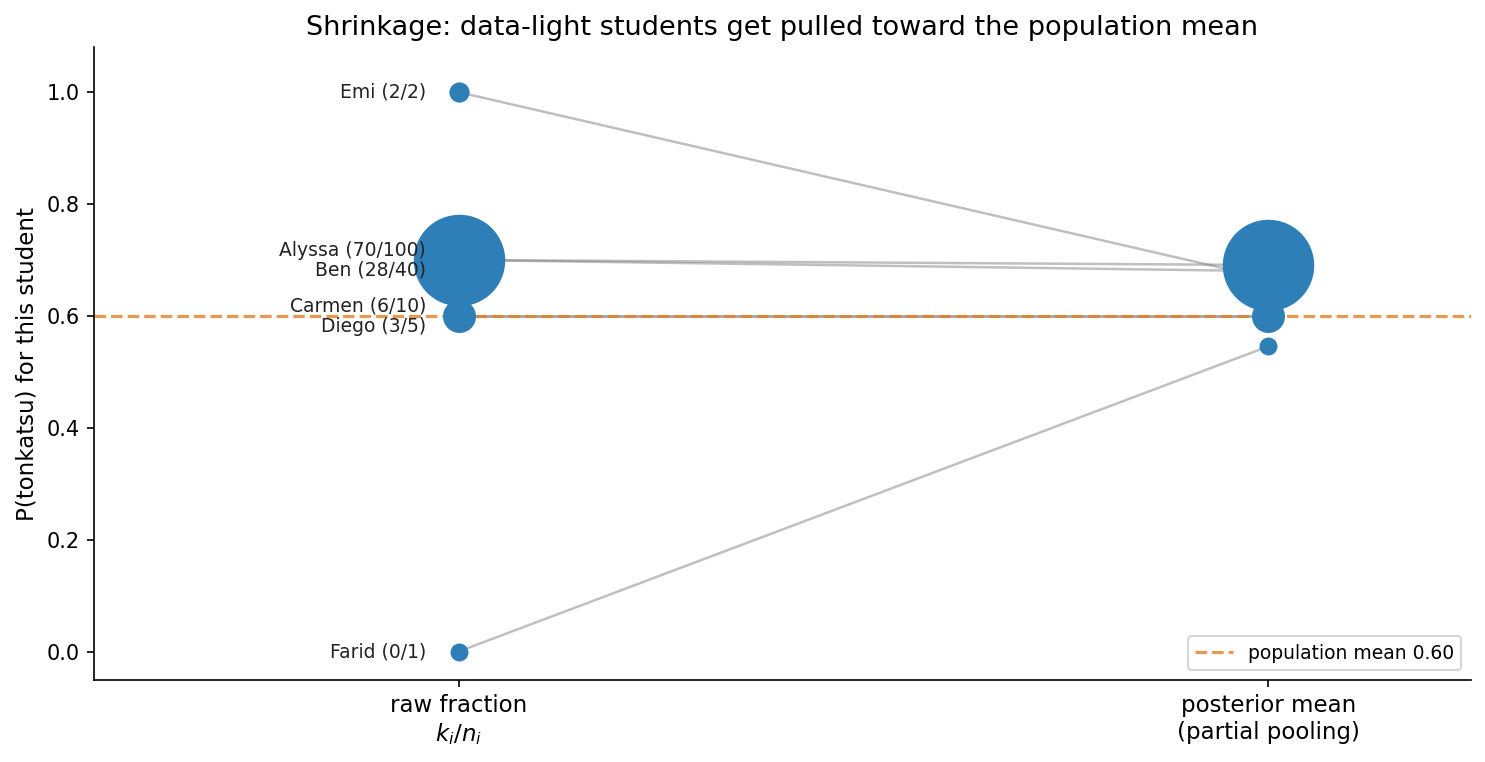
The figure makes the dependence on data size visual: marker size grows with $n_i$, and the small markers (little data) travel the farthest toward the population line, while the big markers stay put.
The hierarchical generative process
What we just computed by formula has a generative story — a recipe for how the data could have been produced — and writing it down is what makes it a hierarchical model. There are three levels:
- A population prior $\text{Beta}(a, b)$ sits at the top.
- Each student draws their own rate from it: $\theta_i \sim \text{Beta}(a, b)$.
- Each student’s bentos are tonkatsu-or-not at that rate: $k_i \sim \text{Binomial}(n_i, \theta_i)$.
In symbols, the three-level hierarchy is:
$$(a, b) \sim \text{prior}, \qquad \theta_i \mid a, b \sim \text{Beta}(a, b), \qquad k_i \mid \theta_i \sim \text{Binomial}(n_i, \theta_i).$$
New term: the Binomial
$\text{Binomial}(n, \theta)$ is the distribution of the count of successes in $n$ independent yes/no trials,
each with success probability $\theta$ — here, the number of tonkatsu bentos out of $n$. It’s just $n$
Bernoulli (flip) trials added up. We met flip (one trial) throughout the GenJAX tutorial; the Binomial is
the count of many such flips.
The dependence structure — who is drawn from whom — is a picture of arrows. The shared $(a, b)$ feeds every student’s $\theta_i$, and each $\theta_i$ feeds that student’s count $k_i$:
graph TB
    AB(("(a, b)<br/>population<br/>prior")) --> T1(("θ₁<br/>Alyssa's<br/>rate"))
    AB --> T2(("θ₂<br/>Ben's<br/>rate"))
    AB --> Td(("…"))
    AB --> TJ(("θⱼ<br/>student j's<br/>rate"))
    T1 --> K1(("k₁ | n₁"))
    T2 --> K2(("k₂ | n₂"))
    TJ --> KJ(("kⱼ | nⱼ"))

    classDef hidden fill:none,stroke:#9bbcff,stroke-width:2px,color:#fff
    classDef observed fill:#cfd6e6,stroke:#9bbcff,stroke-width:2px,color:#111
    class AB,T1,T2,Td,TJ hidden
    class K1,K2,KJ observed
The shaded k | n nodes are the observed bento counts; the unshaded $(a, b)$ and per-student rates $\theta_i$ are the latent quantities we infer. The shared parent $(a, b)$ is why the students aren’t independent: learning about one student’s rate tells you a little about the population, which tells you a little about every other student. That coupling is exactly the channel through which strength is borrowed.
Here is the generative process as a GenJAX model — one @gen function for a single student, run across a whole
population with jax.vmap:
| |
Output:
simulated tonkatsu counts: [69, 30, 4, 2, 2, 1]
out of bento counts:      [100, 40, 10, 5, 2, 1]
The heavy bringers (100, 40 bentos) land near the 0.6 population rate (69/100, 30/40); the light bringers are scattered (4/10, 2/2, 1/1) — which is precisely why their raw fractions can’t be trusted, and why the shared prior matters.