The Beta Distribution
The Beta distribution (a prior for a probability)
To pool partially we need a prior over a rate $\theta \in [0, 1]$ — a probability distribution whose outcomes are themselves probabilities. The natural choice is the Beta distribution, written $\text{Beta}(a, b)$, and it is the one new piece of notation in this chapter.
Define-before-use: the Beta distribution
$\text{Beta}(a, b)$ is a probability distribution over a single number $\theta$ between 0 and 1. It has two shape parameters $a > 0$ and $b > 0$, and the most useful way to read them is as a soft count:
$a$ is “how many prior tonkatsu you’ve imagined seeing,” and $b$ is “how many prior hamburgers.”
Its mean is
$$\mathbb{E}[\theta] = \frac{a}{a + b},$$
and the total $a + b$ acts like a prior sample size — the bigger it is, the more sharply the distribution concentrates around its mean. A few shapes worth knowing:
- $\text{Beta}(1, 1)$ is flat — every rate equally likely (the uniform distribution on $[0,1]$).
- $\text{Beta}(8, 2)$ is peaked near 0.8 — “I strongly expect a high tonkatsu rate.”
- $\text{Beta}(2, 5)$ is skewed low, mean $\approx 0.29$ — “probably a low rate.”
![Three Beta density curves over θ in [0,1]: a flat light-blue line for Beta(1,1) (uniform), a dark-blue curve for Beta(8,2) peaked near 0.8, and an orange curve for Beta(2,5) skewed toward low values with its peak (mode) near 0.2 and mean near 0.29. The figure illustrates that (a,b) behave like a soft count of prior tonkatsu vs. hamburger, with the mean at a/(a+b).](../../../images/intro2/hb_beta_shapes.png)
The mean isn’t the whole story: concentration
Here is a subtlety that matters enormously for hierarchical models, and it’s easy to miss. The Beta’s mean $a/(a+b)$ tells you the typical student’s rate — but two populations can share the same mean and yet describe completely different worlds. What separates them is the concentration $a + b$: how tightly the students cluster around that mean.
Hold the mean fixed at $0.5$ (equal soft-counts, $a = b$) and slide the concentration:
- Small $a + b$ — e.g. $\text{Beta}(0.1, 0.1)$. The density piles up at the edges, $\theta \approx 0$ and $\theta \approx 1$, and is nearly empty in the middle (a U-shape). This says: each student is highly consistent — they almost always bring tonkatsu, or almost always bring hamburger — but students differ wildly from each other. The variability lives between students; within any one student there’s almost none.
- Large $a + b$ — e.g. $\text{Beta}(10, 10)$. The density is a tight bump centered on $0.5$. This says the opposite: every student is individually a coin-flip — each one personally brings tonkatsu about half the time — and students are all alike. Now the variability lives within each student; between students there’s almost none.
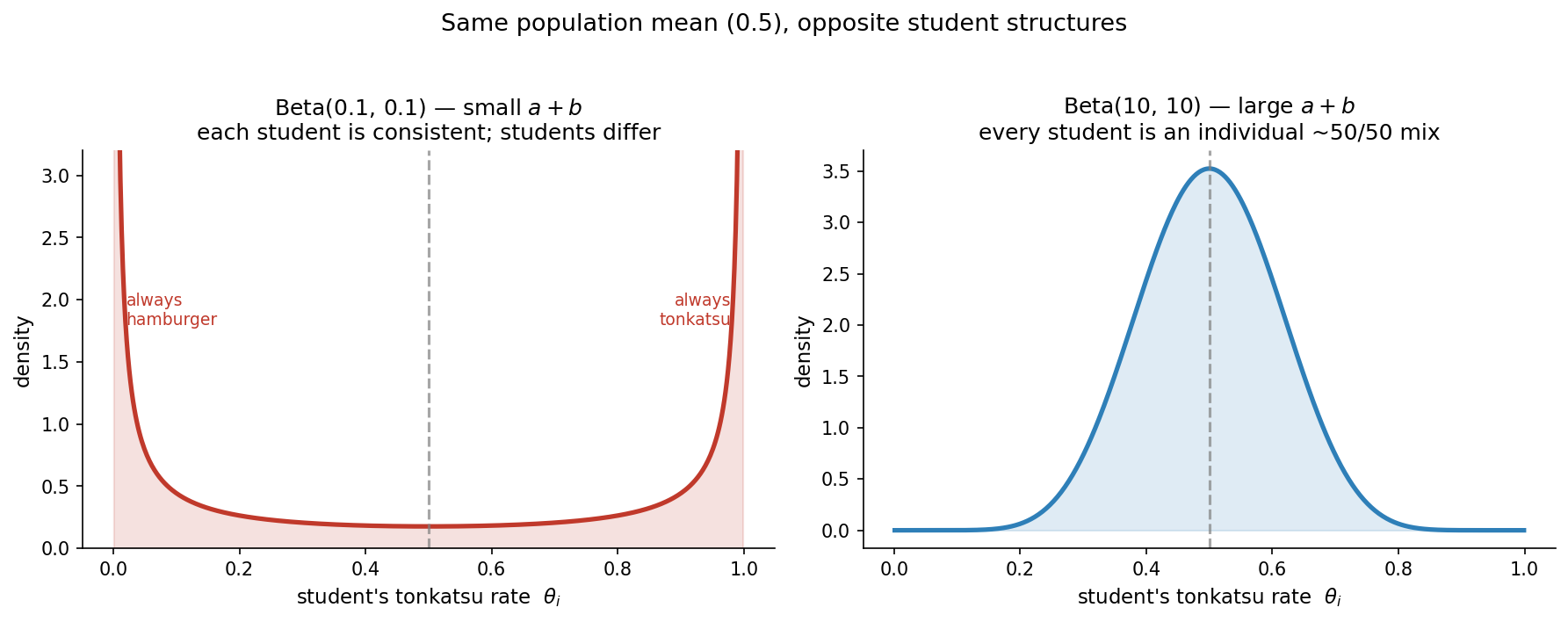
Same population mean, opposite stories about where the randomness lives. Let’s see it in samples: draw 5000 students from each population (each student gets a personal rate $\theta_i$ and brings 20 bentos) and measure the between-student spread.
| |
Output:
Small a+b  -- Beta(0.1, 0.1):
  population mean rate        = 0.50
  spread BETWEEN students (SD)= 0.46
  fraction near 0 or 1        = 0.81

Large a+b  -- Beta(10, 10):
  population mean rate        = 0.50
  spread BETWEEN students (SD)= 0.11
  fraction near 0 or 1        = 0.00
Both populations average $0.50$ tonkatsu — but in the small-$a+b$ world 81% of students are near-deterministic (always one or the other), while in the large-$a+b$ world none are: everybody is a genuine $50/50$ mix. The same point holds at any mean — make it $a:b = 7:3$ instead of $1:1$ and you get a population averaging $0.70$, either as “most students are reliably tonkatsu-or-hamburger people, leaning tonkatsu” (small $a+b$) or “every student personally brings tonkatsu about 70% of the time” (large $a+b$).
This is exactly what hierarchical Bayes infers. When we learn $(a, b)$ from data later in this chapter, we’re not just learning the average student — we’re learning the concentration, i.e. how much students differ, and that is precisely what decides how hard to shrink. A large inferred $a + b$ (students are alike) shrinks everyone hard toward the group; a small one (students differ) trusts each student’s own data more. Concentration is the knob that controls borrowing strength.
The reason the Beta is the prior for a rate is a happy algebraic accident called conjugacy — the prior and the posterior come out in the same family, so updating just shifts the parameters. You already met this in a different costume in Chapter 4: there, a Gaussian prior on a Gaussian mean gave a Gaussian posterior. Here, a Beta prior on a Bernoulli rate gives a Beta posterior — and the update is just counting:
$$\text{prior } \text{Beta}(a, b) ;+; \text{data } (k \text{ tonkatsu out of } n) ;\longrightarrow; \text{posterior } \text{Beta}(a + k,; b + n - k).$$
You add the observed tonkatsu to $a$ and the observed hamburgers to $b$. That’s the whole update. The posterior mean is therefore
$$\mathbb{E}[\theta \mid k, n] = \frac{a + k}{a + b + n},$$
which is exactly a blend of the prior soft-count and the real data — and, crucially, the blend tips toward the data as $n$ grows. Hold onto that formula; it is shrinkage, and the next section reads it off directly.